Features
Everything the office runs on.
Visatory is one system for the whole agency, not a pipeline tool bolted to an accounting package. Below is what is actually in it.
01
Pipeline
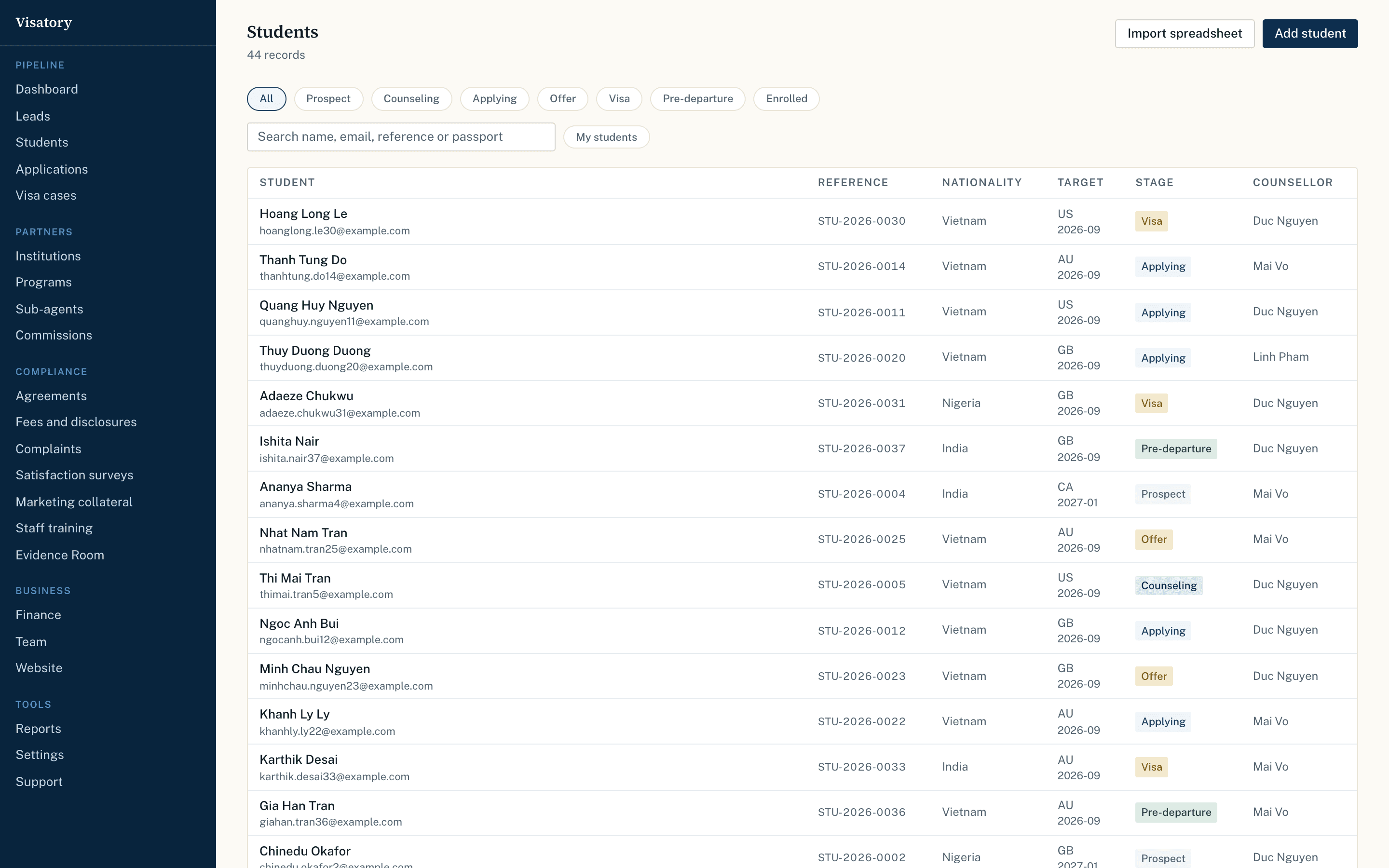
From the first enquiry to the day a student enrols, in one place your whole team can see.
Leads and follow-ups
Enquiries from website forms, referrals, fairs and sub-agents, each with an owner, a stage and a follow-up date. Overdue follow-ups surface on the dashboard.
Student profiles
Passport details, education history, English test scores, target countries and intake, funding source, and every guardian - with the counselling notes that go with them.
Guardians and minors
Parents and sponsors are first-class records. A student under eighteen cannot have an application submitted without a guardian on file.
Applications board
A real state machine, not a free-text status. Submitting is refused with a list of what to fix - outstanding documents, a flagged file, a missing guardian.
Institution and program catalogue
Tuition, entry requirements, intakes, credit transferability, and the date each program was last verified - so nobody quotes last year's fees.
Document checklists
Per-application requirements that can be waived with a reason, so the exception is recorded rather than remembered.
Agency website
Three templates over one block system, with lead forms that land straight in the pipeline. Bring your own domain.
02
Visas
Four destinations modelled as the genuinely different processes they are, and editable when the rules move.
Per-country milestone tracks
United States (I-20, SEVIS fee, DS-160, interview), United Kingdom (CAS, maintenance funds, health surcharge), Canada (letter of acceptance, provincial attestation, biometrics) and Australia (CoE, genuine-student statement).
Owners and due dates
Each step says who it is waiting on - your office, the student, the school or a government - and when it is due, projected from the step before it.
Editable templates
Governments change requirements mid-intake. Edit a track and new cases follow it while cases already in flight keep the one they started on.
Refusals recorded verbatim
A reapplication turns on the exact wording of the refusal, so it is captured as written rather than paraphrased from memory six weeks later.
03
Money
The part agencies most often lose track of, and the part that pays for everything.
Commission receivables
Projected from a per-institution rate card when a student accepts, held until the census date passes, then invoiced and reconciled against what actually arrived.
Sub-agent splits
Payables keyed to the receivable, so you never owe a partner money you have not been paid.
Student invoices and payments
Service fees, deposits and receipts, with a cashbook for the office.
Fee schedules
Published with a refund policy and versioned, so every student disclosure points at the version that student was actually shown.
04
Records
Evidence accumulates as a by-product of the work, so producing it later is a download rather than a fortnight.
Document provenance
Where every file came from - the student, a guardian, the institution directly, a sub-agent - recorded on upload, with a checksum.
Authenticity checks
Marking a document verified is a separate act by a named person who states how they checked it. Flagging never deletes.
Versioned agreements
Student, institution and sub-agent contracts, with the signed copy attached and the template version the signatory actually saw.
Complaints and corrective actions
A complaint cannot be resolved without recording what changed as a result - which is the part a reviewer reads.
Consent and disclosure logs
One record of what a student permitted, and a separate one of what was actually sent, to whom, and when.
One-click records pack
Pick a date range and export student files, agreements, disclosures, complaints, surveys and training as a single pack with a manifest.
05
Foundations
The decisions underneath, which matter more the longer you use it.
A database per agency
Your data lives in its own database, not in a shared table with a column naming you. Deleting an agency means dropping a database, not hoping a filter held.
Branches and roles
Multiple offices with per-branch visibility, and roles you can edit - counsellor, visa officer, accountant, marketing.
Sign-in without passwords
A six-digit code by email. Nothing to write on a sticky note, nothing to hand over when someone leaves, and no password hash to leak.
An audit trail you can read
Who changed what and when, kept beyond the life of the record it describes and exported with the records pack.